My blog has moved!

You should be automatically redirected in 6 seconds. If not, visit
http://ingenioustries.com/blog/
and update your bookmarks.

My name's Joel Kelly and I live in Halifax, NS.

I'm a 20something guy doing digital and social media strategy for a Halifax-based marketing agency.

I'm a vegan nerd and marketing asshole.

You should follow me on Twitter.

Contact me about whatever (like, say, your marketing questions) at joelkellyATgmail.com
Showing posts with label social objects. Show all posts

Tuesday, June 30, 2009

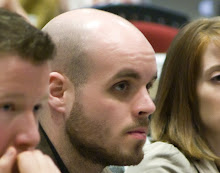
So I guess this is a beard blog now

Most of the comments on my first ever video post (how exciting and modern!) were about my facial hair. And there were lots of tweets about the beard, too.


I'm not entirely certain how I feel about that (yes I am, I think it's rad), but in any case it brings up an interesting thing to consider.

Nobody gives a shit about your video post, or about the content. The only important thing is whether people want to talk about it.

Sure, people didn't talk about precisely what I'd hoped they would, but they (you) talked.

It gave people something to talk about on a Monday. The conversation about my horrible beard probably made a few people chuckle. Not the video, not the beard, but the conversation.

That's interesting, that's cool. And maybe that makes this blog a little bit more worth coming back to.

Conversation is the point, after all. Rad.

EDIT: See Anonymous's great comment (2nd one down) about this. He/she makes some great points.

Monday, April 27, 2009

Everybody needs an elephant


So I spoke at the AIM Conference in Halifax this week about how businesses can make their marketing more social. You know, giving people something worth talking about, and helping facilitate the conversation. I thought I'd write about one of my favourite points in the talk.
Everybody needs an elephant.

Well, something like that. This came to me while having a conversation with a friend a couple weeks back. The inevitable and obvious question of "What's new?" got asked, and neither of us had anything particularly interesting to say.

So he suggested that he should just buy an elephant. That way, there would always be something to answer that question with.

"Just trying to figure out if I'm going with an Indian or African elephant."

"Oh, I'm still haggling with the owner."

"Would you believe it? Damn thing's caught up in customs."

You could go on and on about how the paddock construction is going. How much food you have to buy, and on and on. Actually, the thing never really has to arrive.

It's just something to talk about.

And everyone's looking for something to talk about.

People will go to extraordinary lengths to have something new to talk about. Hell, we'll even pay tons of money on a vacation just to have the subject of new conversations.

Does your business do anything that might give me something to talk about? Are you at all helping me buy my elephant? Are you so interesting that you can replace the elephant?

Does your business have a blog that's regularly updating with things I can bring up with coworkers? Does your packaging include funny or fascinating takes on the industry you're in?

If you make cutlery, why doesn't your packaging say how many forks are made worldwide in a day? Why don't you tell me a bit about the history of modern cutlery? When company comes over, I'll have something to talk about.

If not, I guess I have to keep trying to buy that elephant. And that's a bit of a pain. Too bad you couldn't help.

Sunday, December 7, 2008

Social media IS NOT its networks

So stop saying it, please.

Your social media strategy is not to start using Flickr and Facebook to spread your message, okay?

First, a tactic is not a strategy.

Social media strategy is about figuring out, first of all, why people should care. It's what Mark Earls calls the "What For?" of a business:

"Put really simply, the Purpose-Idea is the "What For?" of a business, or any kind of community. What exists to change (or protect) in the world, why employees get out of bed in the morning, what difference the business seeks to make on behalf of customers and employees and everyone else? BTW this is not "mission, vision, values" territory - it's about real drives, passions and beliefs. The stuff that men in suits tend to get embarrassed about because it's personal. But it's the stuff that makes the difference between success and failure, because this kind of stuff brings folk together in all aspects of human life." - gapingvoid.com
So that's how a strategy begins. Now, if you can understand that, and still think that executing a strategy just has to be about using social or peer networks, you've still got a problem.

In the phrase Social Media, "social" is the keyword.

The media is interchangeable.

Social media can take place on the good old sneakernet.

The reason that social networks are used in social media is because they enable people to connect to so many people so quickly. But it's their usefulness that makes them so widely used for social media campaigns, not because the terminology or strategy necessarily demands it.

So please, stop writing what you think is your "social media strategy" by starting off with a list of websites you need to post your content on, as if the media will create the society. It won't.

Communities create networks, not the other way around.

Thursday, November 20, 2008

Social media and tourism

How long do vacations last? A week? Two?

How long does the memory last? Years, likely. If it's a particularly interesting vacation, the memory can last a lifetime.

So which did you pay for, where is the real value? The experience, or the memory?

Neither.

You paid for the conversation.

You paid to be able to talk to all your friends and family and coworkers about the trip you're planning, you paid to get to email your friends from some exotic locale and make them jealous, and you paid to be able to force everyone you know to look at your photos when you got back.

That's the lasting value, that's what you paid for.

So if you're marketing a tourist destination, are you focused on making it a one-off experience, unsharable and proprietary? Or do you facilitate sharing the memories, do you help your customers tell everyone they know about the great trip they had, or the great B&B they stayed in?

Do you have free wi-fi and cheap post cards at your hotel? Do you allow and encourage people to take pictures at your attraction? Do you market yourselves as conversation pieces, or as a single experience?

Hugh talks a lot about social objects, and about the need to identify what your social object is that you're selling. If you can't figure out what it is about your tourist attraction or accommodation that will start people talking, that will get people to share the memory with their friends, you're in trouble.

And which is more valuable? Tons of ads, or a few people telling everyone they know about how great their trip was? Which one will get more people interested?

Which one are you focusing your marketing budget on?